Demos
Demos  Colors
  Docs
Docs  Support





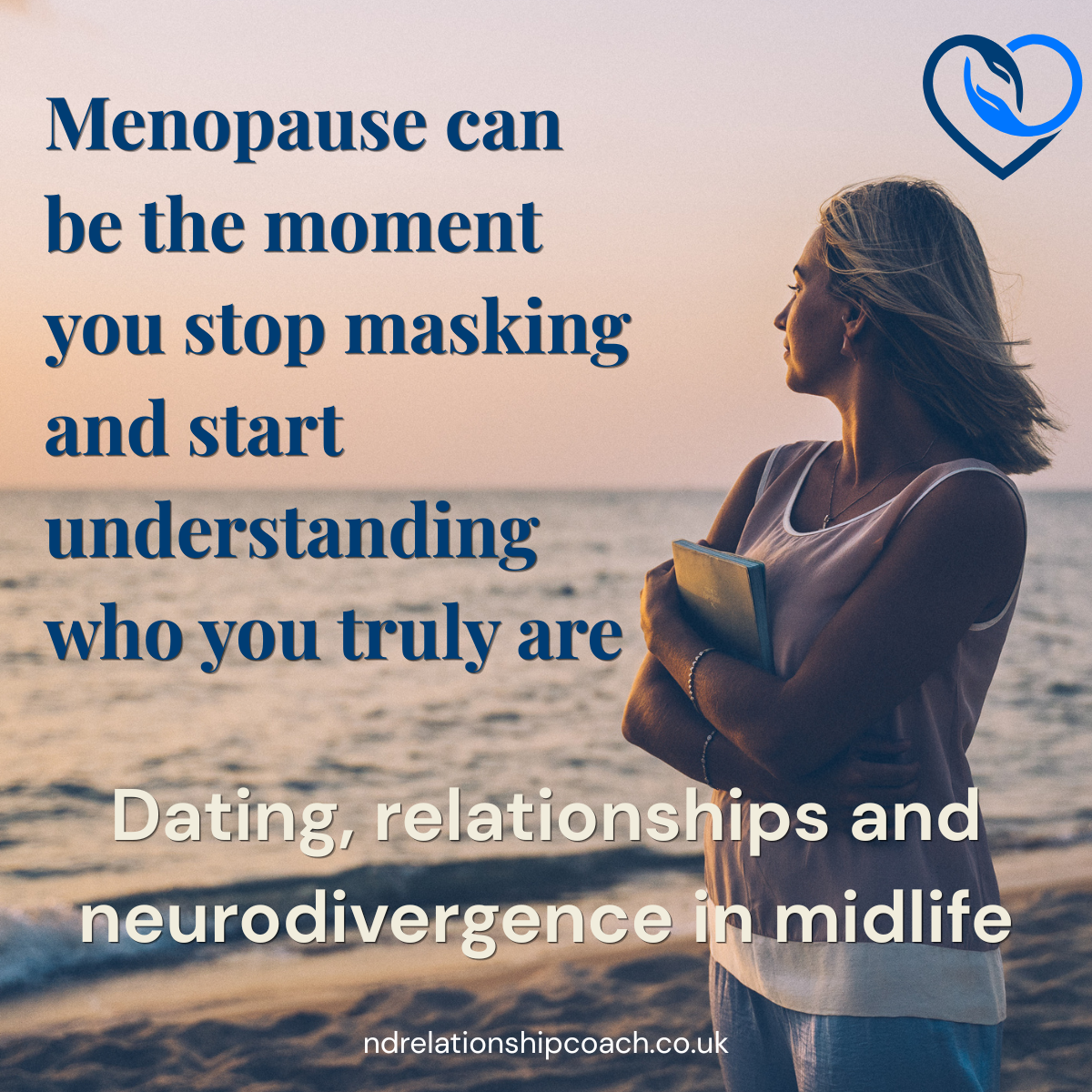
Menopause Can Be the Moment You Stop Masking and Start Understanding Who You Truly Are
Dating, Relationships, Neurodivergence and a Late ADHD Diagnosis in Midlife
I went to my GP with a list.
Not a short list scribbled on the back of an envelope. A proper list.
The kind of list you create when you’re trying to make sense of changes that seem to be appearing from every direction at once.
Brain fog.
Forgetfulness.
Overwhelm.
Difficulty concentrating.
Mood swings.
Exhaustion and many more.
Like many women in midlife, I assumed the answer was menopause.
After all, I was at that stage of life. The symptoms seemed to fit. Friends were talking about similar experiences. Social media started to see women sharing stories about perimenopause and menopause.
I wasn’t looking for an ADHD diagnosis.
In fact, ADHD wasn’t even on my radar.
I went looking for answers about hormones.
Instead, I found answers about myself.
Looking Back, The Clues Were Always There
At the time, I genuinely believed these challenges had arrived out of nowhere.
But once ADHD entered the conversation, I started looking back at my life through a different lens.
And suddenly, things that had never quite made sense started making a lot more sense.
The constant overthinking.
The feeling that my brain never really switched off.
The tendency to become overwhelmed when there were too many competing demands.
The mental exhaustion that came from trying to stay on top of everything.
The endless lists.
The forgotten appointments.
The last-minute rushes.
The feeling that everyone else seemed to have received a handbook for life that I’d somehow missed.
This wasn’t actually my first experience of receiving a diagnosis.
I was diagnosed with dyslexia when I was 24.
At the time, I thought having an answer would help.
In reality, it left me with mixed feelings.
What I heard wasn’t an explanation.
What I heard was confirmation that I was somehow less than.
I remember being told I was performing well below average in most areas and, if I’m honest, that did very little for my self-esteem.
There wasn’t much conversation about strengths.
There wasn’t much discussion about different ways of thinking.
There certainly wasn’t the neurodiversity-affirming language we hear more often today.
What I took away was the belief that I was lacking something that other people seemed to have.
So I did what many people do.
I worked harder.
I compensated.
I developed strategies.
I became determined not to let people see where I struggled.
Looking back now, I can see how much energy I spent trying to prove myself.
And I wonder how many neurodivergent women have done exactly the same.
Menopause Didn’t Cause My ADHD
Menopause didn’t cause my ADHD.
I’ve always had ADHD.
I just didn’t know it.
What menopause seemed to do was shine a spotlight on coping strategies that had been working quietly in the background for years.
The hormonal changes that come with perimenopause and menopause can affect memory, concentration, emotional regulation and executive functioning.
For many women, that can feel unsettling enough on its own.
But if you’re neurodivergent, those changes can sometimes make it harder to maintain the systems you’ve relied upon for decades.
It’s a bit like trying to keep lots of plates spinning.
You’ve been doing it for years.
You’ve become so good at it that nobody notices how much effort it takes.
Then suddenly, it feels as though you’re spinning them with less energy, less focus and less capacity.
The struggle becomes visible.
Not because you’ve changed.
But because the effort required has increased.
That’s what it felt like for me.
The things I’d always managed to hold together suddenly felt harder to hold.
The mask I’d spent years wearing became much heavier.
The Word I Didn’t Know Applied To Me
Masking.
It’s a word I now use often in my coaching work, but it wasn’t a word I would have used about myself years ago.
I thought I was simply doing what everyone else was doing.
Trying my best.
Pushing through.
Being resilient.
Being capable.
Being the person other people needed me to be.
What I didn’t realise was how much energy I was spending trying to fit expectations that didn’t always fit me.
I became very skilled at appearing fine.
Many neurodivergent women do.
We’re often praised for coping.
Praised for managing.
Praised for getting on with things.
What people don’t always see is what happens behind the scenes.
The exhaustion.
The self-doubt.
The constant mental effort.
The feeling that you’re somehow working twice as hard just to stay in the same place.
Menopause made it harder to ignore those experiences.
And in a strange way, I’m grateful for that.
Because without it, I may never have discovered what was really going on.
The Diagnosis Felt Different This Time
Unlike my dyslexia diagnosis, my ADHD diagnosis felt different.
Perhaps because I was older.
Perhaps because conversations around neurodiversity have changed.
Or perhaps because I was finally ready to see my brain through a lens of understanding rather than deficiency.
There was relief. A huge amount of relief.
Finally, there was an explanation.
Finally, there was a reason why certain things had always felt harder than they seemed to be for other people.
But there was sadness too.
Sadness for the younger version of me who spent years believing she wasn’t trying hard enough.
Years believing she simply needed to be more organised, more focused, more disciplined, more resilient.
Years believing that if she just worked a little harder, she’d finally get it right.
For the first time, I wasn’t asking:
“What’s wrong with me?”
I was asking:
“What do I need?”
That shift changed everything.
What It Changed In My Relationships
One of the biggest shifts wasn’t practical.
It was relational.
Once I understood myself better, I started understanding my relationships differently too.
I became more aware of my needs.
I became better at communicating when I felt overwhelmed.
I became more comfortable asking for support.
I became less interested in pretending everything was fine when it wasn’t.
I started noticing how often I’d prioritised other people’s comfort over my own wellbeing.
How often I’d said yes when I meant no.
How often I’d pushed myself beyond my limits because I didn’t want to disappoint anyone.
As a relationship coach, I often talk about authenticity.
But authenticity can be surprisingly difficult when you’ve spent years masking.
Not because you’re trying to deceive anyone.
But because you’ve become so accustomed to adapting that you’ve lost sight of what you need yourself.
Understanding my neurodivergence didn’t magically solve everything.
But it gave me language.
It gave me context.
And perhaps most importantly, it gave me compassion.
I Wonder How Many Women Are Sitting With Their Own List
One of the reasons I wanted to write this is because I know my experience isn’t unique.
I’ve spoken to so many women who have found themselves questioning things during perimenopause and menopause.
Women who suddenly feel more overwhelmed.
Women who can’t understand why their usual coping strategies aren’t working.
Women who feel like they’ve somehow lost themselves.
Sometimes menopause is exactly what it appears to be.
Sometimes it isn’t.
And sometimes it’s both.
Sometimes the conversation that starts with hormones ends somewhere completely unexpected.
If that’s where you find yourself, I want to gently encourage curiosity.
Not self-diagnosis.
Not panic.
Just curiosity.
What stories have you been telling yourself about your struggles?
What if the problem isn’t who you are, but how you’ve learned to view yourself?
What if understanding creates more change than fixing?
The Unexpected Gift
If you’d told me a few years ago that a GP appointment about menopause would lead to an ADHD diagnosis, I wouldn’t have believed you.
Yet here we are.
Looking back now, I don’t see my diagnosis as a label.
I see it as understanding.
I see it as permission to stop fighting battles I never needed to fight.
I see it as an invitation to be kinder to myself.
Menopause is often talked about as something women have to get through.
Something to survive.
Something to endure.
But for me, it became something else.
It became a turning point.
A moment that encouraged me to question old assumptions.
A moment that helped me understand myself more deeply than I ever had before.
Menopause didn’t cause my ADHD. But it did help me finally understand it.
And perhaps that’s one of the unexpected gifts hidden within some of life’s most challenging transitions.
Sometimes the thing you think is the problem isn’t actually the whole story.
Sometimes it’s simply the thing that points you towards the answer.
If this resonates, you are welcome to book a free chemistry call.
👉 Book your chemistry call here.
Because you don’t need to become less sensitive, less thoughtful, or less you.
ND Relationship Coach supports neurodivergent individuals in understanding their relationship patterns, communication styles and emotional needs in connection.
You deserve love that feels safe, steady, and real, love built for your brain. 💜
Related Posts
Why Healthy Love Can Feel Uncomfortable
When calm feels unfamiliar, it doesn’t always mean something is missing. Have you ever met…
Maybe It’s Not Your Taste in Partners. Maybe It’s Your History.
Maybe It’s Not Your Taste in Partners. Maybe It’s Your History. How our experiences quietly…
Menopause Can Be the Moment You Stop Masking and Start Understanding Who You Truly Are
Menopause Can Be the Moment You Stop Masking and Start Understanding Who You Truly Are…
When it’s not love, it’s fear (how to tell the difference in dating)
When it’s not love, it’s fear (how to tell the difference in dating) I was…